Imagine going 45 days without internet. During a pandemic.
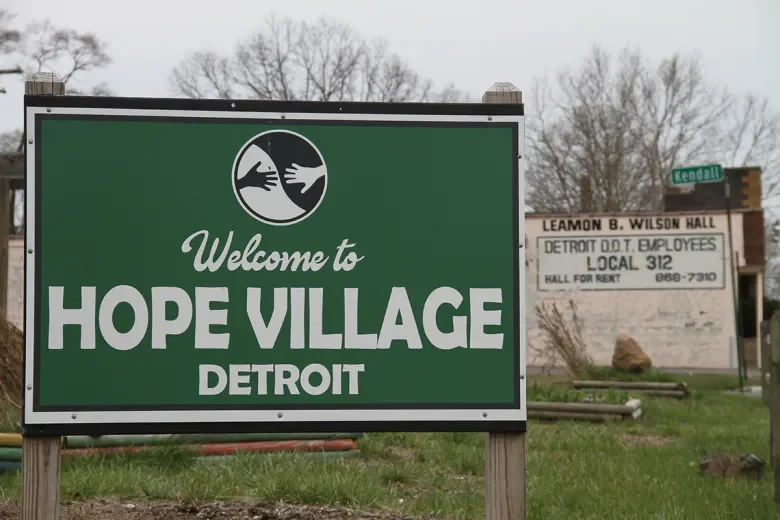
In the fall of 2020, residents of Hope Village, a neighborhood in Detroit, experienced a 45 day internet outage—cut off from work, school, healthcare, and connection. Since 2015, the City of Detroit has been one of the country’s worst digitally connected cities. As of 2020, 63% of low-income homes in the city have no in-home internet broadband, while 38% of homes have no internet connection at all.
With this in mind, The City Government of Detroit joined The Opportunity Project for Cities, a 20-week design sprint on addressing public challenges with open data and community co-creation. The project was coordinated by Centre for Public Impact, the Beeck Center at Georgetown University, the Knight Foundation, and Google.org.

As the UX lead on the project, I guided the project team in conducting and synthesizing user research, facilitating design exercises, prototyping, and testing solutions with actual Detroit residents. The progress made by our design sprint helped the City secure a $11.1 million fiber optics internet investment in Hope Village, paving the way for a more connected and equitable future in Detroit.
From the outset, our project team was focused on one question:
How might we collect internet performance data from residents easily, and display it to increase transparency and accountability?
Discovery
As the UX lead from Google.org, I guided the team through community research. We started with an online survey through Google Forms and followed up with phone calls for residents less comfortable with technology. Our findings were:
Most residents experience 1–5 internet outages every 6 months
Outages often last multiple hours
There was no easy way to report issues or track whether others were affected
Residents were frustrated and felt powerless. The lack of performance data made it difficult to advocate for change.
“My grandchildren were in after school programs in the summer to get ahead. We had to go somewhere for them to complete the work.”
Ideation
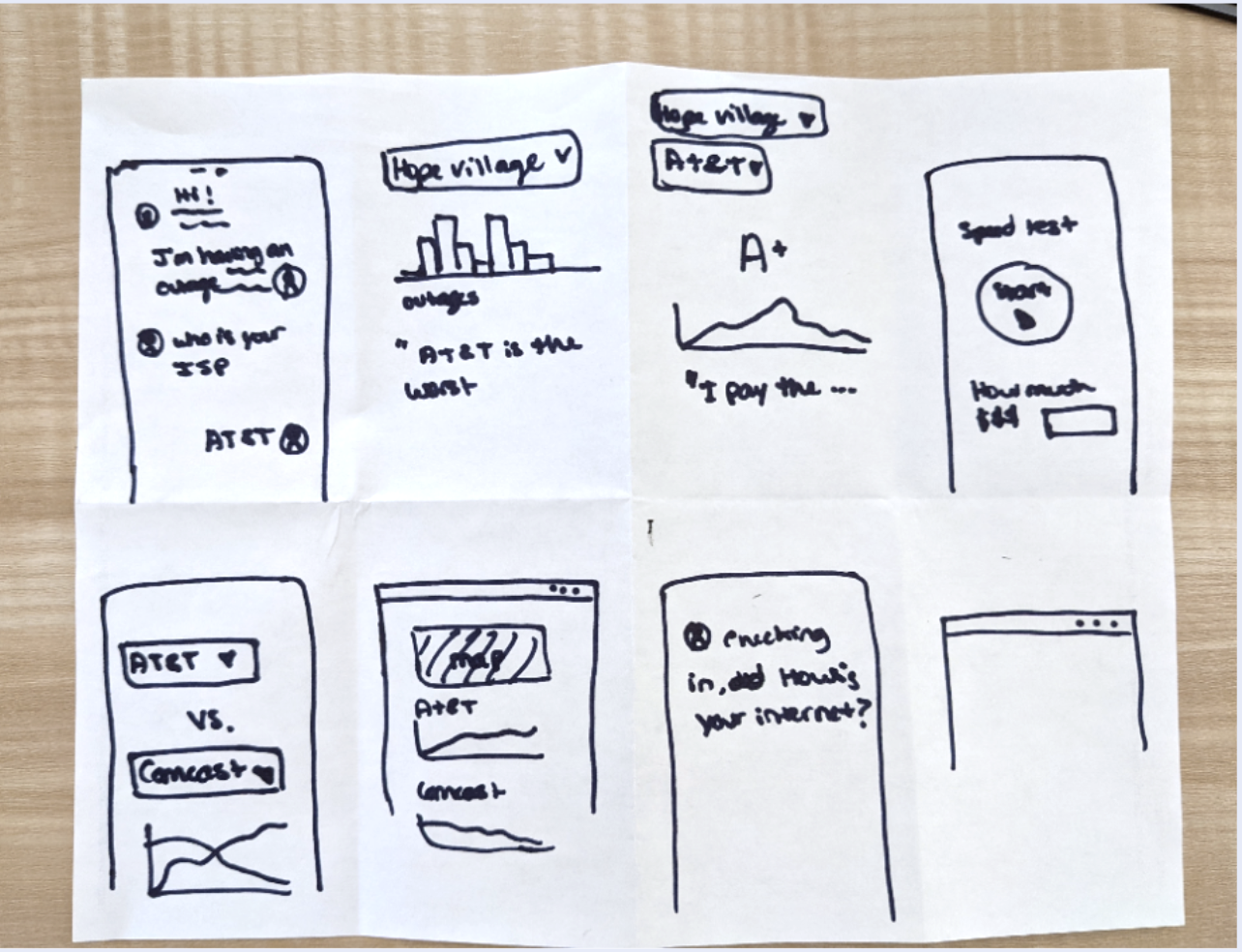
To kickstart ideation, I facilitated a Crazy 8s design brainstorm to explore concepts. Some early ideas included:
An SMS chatbot to report outages via phone
Kiosks in public spaces like McDonald’s, where residents could report issues and access internet immediately
A physical posting board in the neighborhood where residents could post their outages
Prototyping
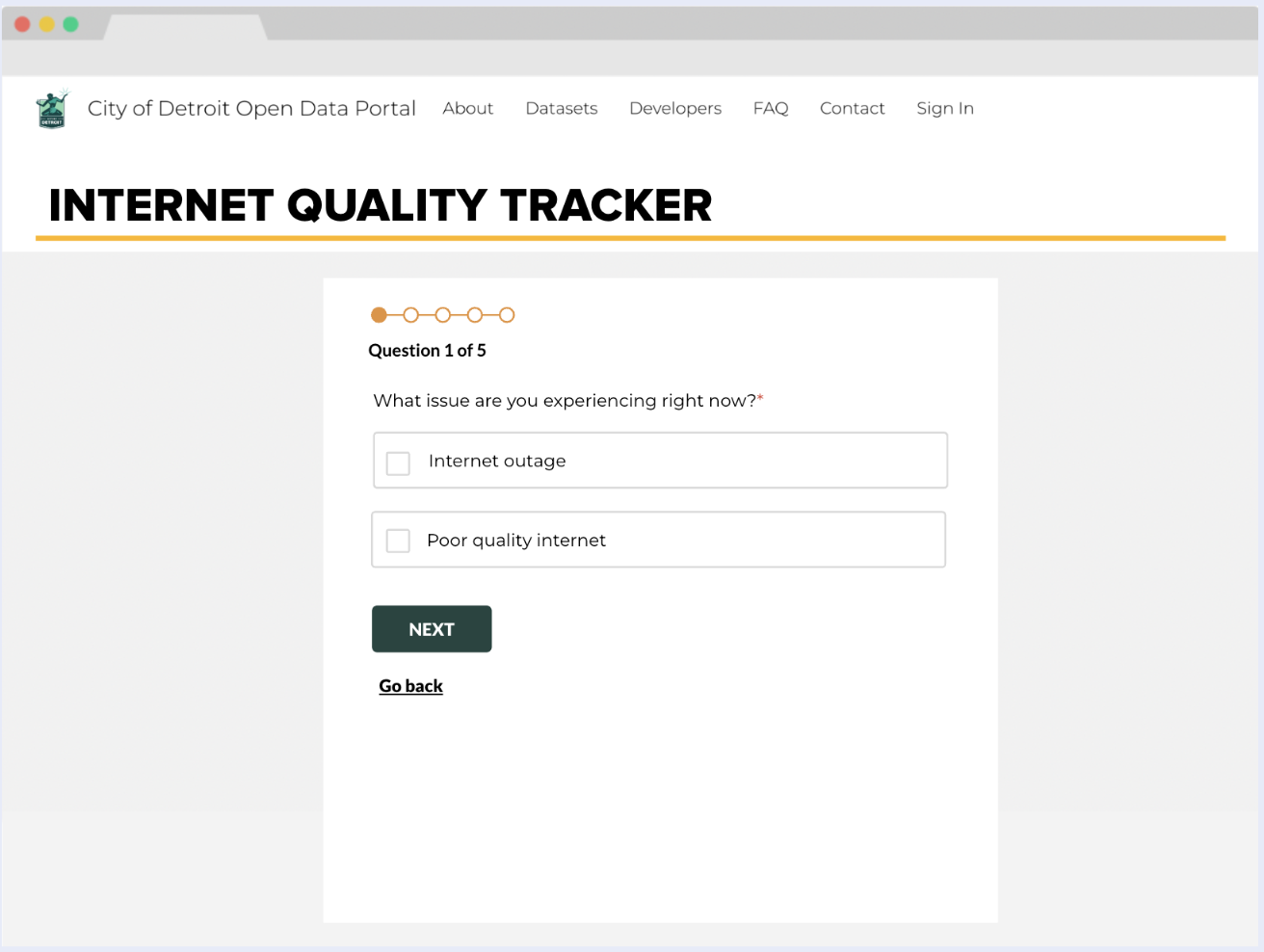
Given our timeline and budget, we landed on an online reporting form to let residents log outages, plus an interactive dashboard to visualize community-wide patterns.
We quickly built and usability tested the online form. While residents appreciated the idea, we heard clear feedback:
“I don’t remember the exact details of every outage.”
“Fill out this form? It’s one more thing to do—on top of not having internet.”
Our original idea—easy resident reporting—wasn’t so easy after all.
So now our team was faced with a new challenge:
Could we collect data without burdening residents?
Initially, a solution that involved automated hardware felt out of reach. But thanks to a partnership with the University of Chicago’s Internet Equity Initiative, the City was able to procure a handful of raspberry pi devices for our team. We worked with the University of Chicago to lay the groundwork for an open-source code and data platform to measure real-time internet performance. Residents could simply plug in the custom-built device and forget about it—while safe, anonymized data flowed to the City.
The online form we built was launched as part of an education toolkit to help residents troubleshoot connectivity and understand their rights.
A year later, the city of Detroit secured That effort will begin in Hope Village. An initial $10M investment will be made in the west side Detroit neighborhood to begin installing fiber optic lines as early as this summer. Approximately 5,700 residents live in 2,000+ homes in the area between the Lodge and Davison Freeways, Dexter to the west, and Hamilton to the east.
Impact
A year later, with the support of the progress made by our design sprint, the City of Detroit secured $11.1 million in federal funding for fiber optics internet investment in Hope Village the surrounding area, affecting approximately 5,700 residents across 2,000+ homes. This investment will help bridge the digital divide in Detroit, and pave the way for a more connected and equitable future.
This project reminded me that community-led design isn’t always linear. While the final solution wasn’t the one we first imagined, it was the one residents needed.
Designing for equity requires flexibility, humility, and collaboration. I’m proud to have helped create not just digital tools—but a foundation for lasting change.